

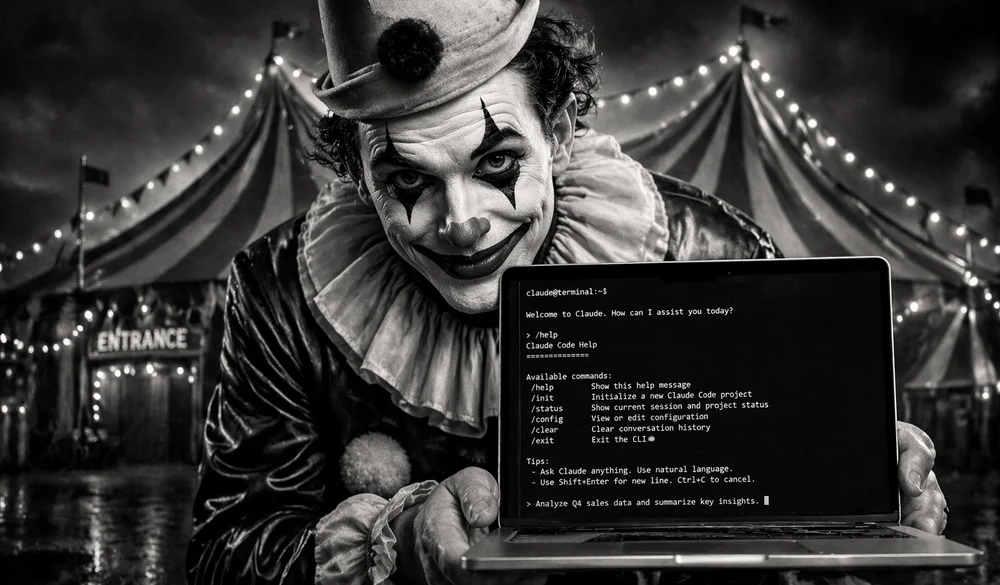
What if it’s all a lie?
What if we’ve fallen for the oldest trick in the book?
The dealer’s playbook: the first taste is free.
Lately, it feels like Anthropic, OpenAI, and the rest are just burning VC money to chase market share. We call it “burning cash.” They call it “pre-revenue.”
But what if this is the strategy?
Not a race to profitability.
A deliberate setup.
Not a search for a business model.
A tax on the future.
What if they’ve intentionally let us burn millions in tokens - by design?
- Build the hype
- Build the FOMO
- Build the quiet sense of inevitability
No ad spend required. Just social media power users convincing us that this time is different.
They aren’t just capturing a market.
They’re creating a generation of developers who can’t function without them.
It starts innocently. A weekend project. A bug you don’t feel like debugging. Idle curiosity.
You paste something in, and it works. Not perfectly - but close enough that you don’t go back.
The trap is set
At first, it feels like leverage.
You’re faster. Cleaner. More effective.
You stop searching.
Stop digging through bad docs and abandoned forums.
Stop writing the same boilerplate you’ve written a hundred times before.
And nothing breaks.
Things feel better- because it is better.
But beneath that improvement, something subtle shifts.
Not in what you produce-
in how you produce it.
You stop thinking in problems-
and start thinking in prompts.
You stop building from first principles-
and start iterating on suggestions.
You’re still in control. Mostly.
The lock-in is not in your code. It’s your workflow.
SaaS used to lock in your data - CRMs, ERPs, dashboards. Once your data lived there, you couldn’t leave.
This is different.
It’s your process that has been captured.
Your habits.
Your reflexes.
Your sense of what “normal” even feels like.
And habits don’t feel like constraints. They feel like preference.
You don’t notice the dependency forming- because it feels like productivity.
The inversion
And then it spreads.
A script here. A refactor there. Something to unblock yourself and keep momentum.
No one objects.
Why would they?
You’re shipping faster.
As turnaround times shrink, expectations have already adjusted. Quietly, almost invisibly, the baseline moves.
This is the inversion.
The tool didn’t get adopted-
the expectations did.
And once expectations shift, there’s no going back.
What used to be exceptional
becomes the baseline.
Not using it doesn’t look principled. It looks like underperforming.
The advantage became a requirement-
then a dependency.
By the time leadership notices, it’s already done. The workflow has changed. The baseline moved.
This isn’t strategic adoption.
It’s retrospective justification.
Monetization
That’s when the model flips.
Until now, everything has been cheap. Loose. Generous. The Pundits decry “There’s no business model here.”
But once it’s embedded - once timelines assume it, once teams depend on it - the economics change.
Price isn’t a barrier- it’s a tax.
Not on usage… on the way work gets done.
By the time you notice, it’s already normal. It isn’t a tool anymore. It’s just… how work gets done.
The prompts get shorter. The trust gets higher.
You stop double-checking everything.
Then you stop checking at all.
Not because you’re careless- Because you’ve been calibrated.
Without realizing, you’ve quietly started trusting it more than you trust yourself.
Try to go back.
Write something from scratch.
Start with a blank page.
Debug without your lifeline.
You can… but… it feels… wrong.
Slow. Heavy.
Like walking when there’s a car. Like an accountant with only a pen.
Accountants didn’t get faster when Excel arrived. They changed.
The muscle required to do it the old way disappeared- not because they forgot, but because they no longer needed to remember.
The shift
Inside the organization, the language shifts.
No one asks, “Should we use it?”
They ask,
“Why didn’t you?”
Not using it isn’t a principled stand.
It’s just… falling behind.
So the budgets follow.
What used to be optional tooling becomes infrastructure. Procurement stops asking questions, because the alternative isn’t saving money - it’s slowing down.
And no one signs up for that.
We tell ourselves this is fine- that every tool reshapes the work, that this is no different.
Maybe it isn’t.
But most tools didn’t change how you think.
They didn’t sit between you and the first idea.
This one does.
So the question isn’t whether it’s useful. It clearly is.
The question is quieter.
What exactly did we outsource?
Not the code.
Not the writing.
The starting point.
And once you stop starting from zero, you don’t just move faster- You move differently.
And if that’s true…
then the lock-in was never the API.
Never the pricing.
Not even the platform.
It was the shift.
The moment this stopped being a choice and started feeling like the only way.
This isn’t SaaS anymore. It’s infrastructure.
Like electricity.
Like the internet.
You can’t opt out.
You don’t negotiate.
You just pay the bill- because the alternative is darkness.
The first taste wasn’t free. It just didn’t cost money.


