


2025 felt like a long time in the making. There was no cinematic reveal, no sudden breakthrough - just the convergence of things that had been running in parallel for years.
I was finally awarded the job title I’d been chasing for three-ish years. Long enough that, by the time it was rubber-stamped, it had lost most of its meaning. It didn’t feel like a finish line so much as permission. Permission to stop auditioning. Permission to take up a bit more space. Permission to trust my gut.
What surprised me most, though, wasn’t some job title or description. It was how much of my energy this year went into something I’d never really paid attention to before: my headspace.
Not just trying to cultivate a good one - but protecting it. Actively. Deliberately. Defensively.
That’s new for me.
A new headspace
I’ve spent most of my life career with a default pessimism. Not the nihilistic “we’re all doomed” kind (though often that too) - more the quiet, insidious variety.
Assume things will go wrong.
Prepare for the worst.
You’ll never be disappointed when they do.
It’s served me.
But I’ve started to realize that the rocket fuel I used to get off the launchpad is pretty toxic. Now that I’ve reached some altitude, I’m trying to switch to a cleaner fuel.
That decision was tested pretty hard over the summer.
The stress-test
I was dropped into a nightmare project. Under-specified. Under-scoped. Oversold.
A client demanding everything at once, on an impossible timeline, governed by internal rules and hidden KPIs no one could clearly articulate - and no one would let us clarify. All the while, the actual user was kept at arm’s length, so they could be suitably surprised by the reveal.
Like a nightmare Secret Santa - where you first have to build a successful Etsy store from scratch, before attempting a bespoke, million-dollar gift for someone you’d never met.
We didn’t know it at the time, but the whole thing was simply an audition tape. Everything we delivered was thrown away less than a week after the demo.
While we were in it though, it was just chaos. A six-week death march of long hours and constant pressure. You know they’re asking for the impossible, so you smile, say “end of week,” and hope they never mention it again.
The grinding familiarity of being technically capable and strategically doomed.
What I still don’t understand is, why I said yes.
The retrospective
I didn’t have to say yes. I could have bowed out. I could have called it impossible and walked away. I distinctly remember telling my wife, upfront, that it was going to be a disgusting month or two and she was barely going to see me.
And then I did it anyway.
I don’t know if that decision came from ego, vanity, or a lingering need to prove something. To prove that I’m still technical enough to get my hands dirty… or that I still measure myself by how much punishment I can take.
Maybe it was all of the above.
I still haven’t fully unpacked it yet.
What I do know is that it forced a kind of reckoning. Not about whether I could do the work, but about whether I should keep choosing to work like that.
Because alongside that experience, something else was shifting.
Identifying my next challenge
Now that I’d officially been given the nod, I’ve deliberately given myself permission to move into a more executive posture. And a big part of that turned out to be defining what “executive” even means.
I’m in a strange, but privileged position. I’ve been at the company long enough to have been there as it has grown and have first-hand experience of all our usual failure modes.
One of my personal pain points is the distance between sales and delivery.
There’s a place deep in the consulting sales funnel where product design, system design, and feasibility assessment should happen.
Where vision gets forced into something executable.
In that space, deals harden. Expectations calcify.
And by the time something reaches a delivery team, it’s often already broken in ways that are politically difficult to undo.
As usual, maybe XKCD already stated this better than I could years ago…
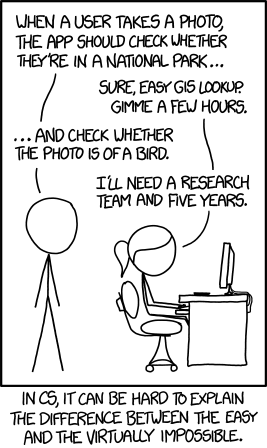
With a bit of nudging, I’ve started moving into that space.
The first green shoots
I’ve inserted myself, and spent more time with, the Sales execs. I’ve been pulled into projects that were supposedly signed and ready to go - immediate starts, with all the usual urgency of an ambulance stuck in rush-hour traffic. Only to discover, once we started deploying staff that there was no there there.
No project. No KPIs. No metrics. No definable deliverables.
Just: “This is Tom. Tom is retiring. Tom has a spreadsheet. We think the spreadsheet might be worth millions.”
That’s not a project. That’s a handoff problem disguised as a strategy.
Turning that kind of nothing into something a delivery team can actually execute has been an interesting pivot. But it’s also made something uncomfortably clear: by the time we’re staffing, it’s already too late.
By then, bad projects have usually hardened into inevitabilities.
If I want to make a real difference, I need to be further upstream. In the sales calls. In the discovery conversations. In the uncomfortable early moments where feasibility still has a chance to matter.
At the same time, my role with people has been shifting too.
People, leadership & decision making
I’ve found myself becoming someone others trust - not just for mentoring, but for the hard stuff.
On one end of the spectrum, I’ve had folks of all levels confide that they really miss being on my team. That’s deeply validating in a quiet way.
At the other end, I’ve also become someone leadership routinely trusts to manage people out when things aren’t working.
It’s a strange duality. Nurturing growth while carrying the weight of difficult exits - often within the same team. It has landed heavier than I expected.
Somewhere in all of this, a lesson reasserted itself. One I’ve learned before, but apparently needed a refresher.
Leadership isn’t about making perfect decisions.
It’s about making the best decision you can with the information you have, knowing full well that you might change your mind next week.
A huge part of my job now is collapsing uncertainty for other people. Taking ambiguity, politics, and chaos - and turning it into something a dev team can move forward with.
Even if it changes later, the act of deciding matters.
Imperfect momentum today, beats paralysis preparing a perfect plan.
That’s a lesson I’m now actively passing on to junior leads. Sometimes the most valuable thing you can do isn’t to find the optimal answer. Sometimes all a team needs is a direction, and trust that you’ll stand behind it, and them.
Just be useful
2025 was the year I stopped trying to be right - and started trying to be useful.
Useful in creating clarity. Useful in making tradeoffs explicit. Useful in protecting my own headspace while helping others navigate uncertainty.
I don’t have all the answers.
But I’m more comfortable now with the responsibility of choosing anyway.


